What County Is Lake Oswego, Oregon In? And How It Affects Property Taxes

Lake Oswego · Community Photo
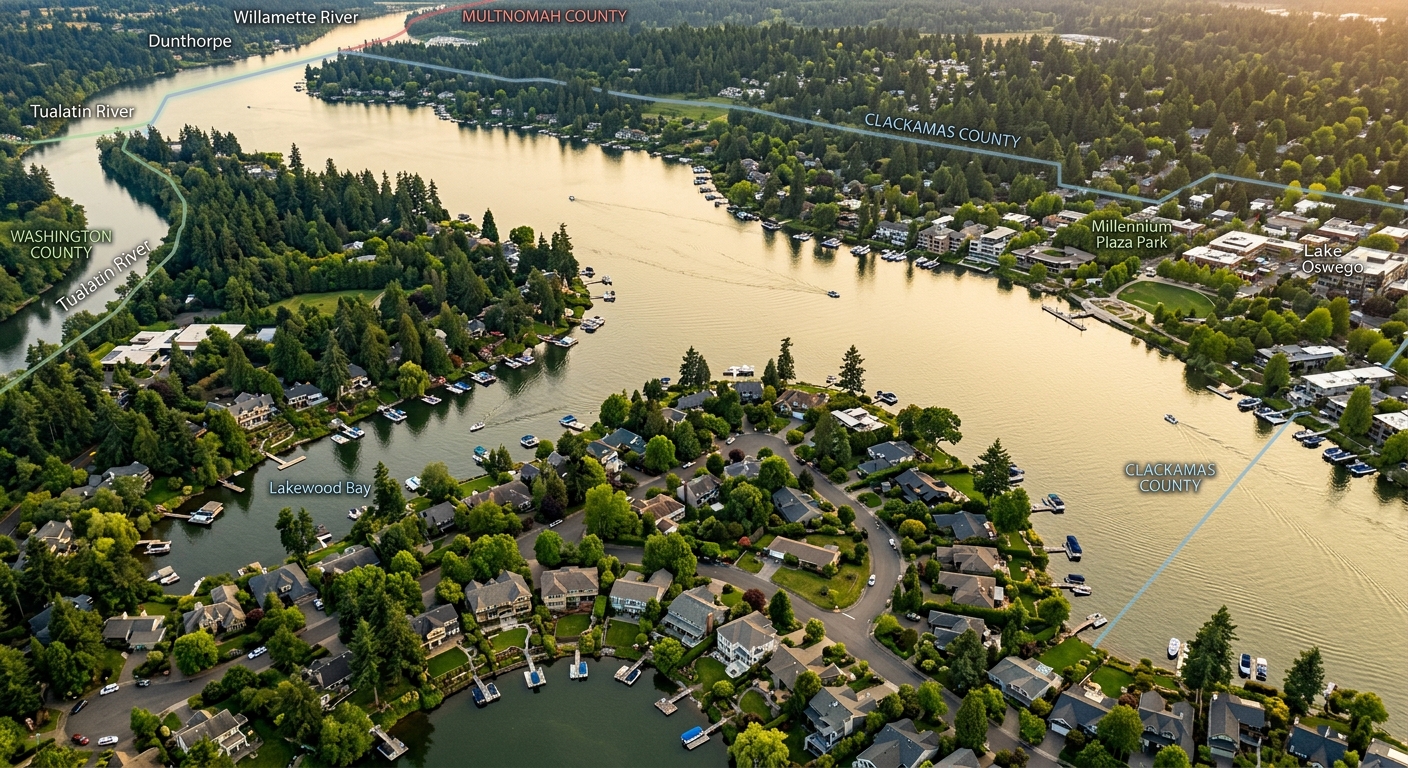
Lake Oswego spans three counties—most of the city sits in Clackamas County, with smaller parcels in Multnomah and Washington counties. Knowing which county your property belongs to determines the tax rate you pay, the bond measures that affect your neighborhood, and the local services that support your home. This clarity helps residents and prospective buyers navigate assessments, budgeting, and community planning with confidence.
Lake Oswego County Overview
The common question what county is Lake Oswego in has a straightforward answer: the majority of the city lies within Clackamas County, while smaller peripheral sections extend into Multnomah County to the north and Washington County to the west.
Geographic Footprint
Clackamas County – Covers most of Lake Oswego’s residential and commercial areas.
Multnomah County – Encompasses a few neighborhoods on the city’s northern edge.
Washington County – Includes a small western pocket of the city.
Impact on Services
City‑wide services such as police protection, public parks, and local zoning are administered uniformly by the City of Lake Oswego, regardless of the county in which a parcel sits.
County‑level governance, however, strictly follows the physical county boundary of each property. This includes:
Property valuation and assessment.
Tax billing and collection.
Public health oversight.
County court jurisdiction.
Why County Matters
If your address falls within the Clackamas portion of Lake Oswego, your property taxes are handled by the Clackamas County Department of Assessment & Taxation. For parcels in the Multnomah or Washington sections, the respective county agencies manage those responsibilities.
Understanding the exact Lake Oswego county location of your property ensures you know where to direct tax inquiries, obtain assessment records, and access county‑specific services.
How County Affects Property Taxes in Lake Oswego
How County Tax Authority Handles Lake Oswego Property Tax
The county in which a parcel is located is the entity that assesses, bills, and collects the tax. For the vast majority of homeowners—those whose homes sit in the portion of the city that falls within Clackamas County—the Clackamas County Property Tax process is administered by the Clackamas County Assessment & Taxation Department. This department determines the assessed value, issues the tax bill, and collects payment directly from the property owner.
After collection, the county tax authority distributes the revenue to the City of Lake Oswego, the Lake Oswego School District, local fire protection districts, library services, and regional transit/metro bond obligations.
Properties that lie in the smaller sections of Lake Oswego extending into Washington County or Multnomah County follow the same procedural steps, but each county applies its own baseline rates and regional measure requirements, resulting in slightly different overall tax amounts.
In Clackamas County, the assessment rates typically range from about 0.98% to 0.99% of the assessed value, a figure that is modestly higher than the Oregon state median of 0.87%.
For more detailed information, visit the City of Lake Oswego Property Tax Information page or the Clackamas County Assessment & Taxation site.
County | Lake Oswego Coverage |
|---|---|
Clackamas County | Most of the City of Lake Oswego is in Clackamas County, representing the majority of parcels. This is where clackamas county property tax and assessment rates apply, and residents refer to the lake oswego property tax rate guidelines set by the county. |
Multnomah County | A small northern edge of Lake Oswego lies within Multnomah County. |
Washington County | A small western sliver of Lake Oswego extends into Washington County. |
How Measure 50 in Oregon Shapes Your Property Tax
Oregon Property Tax Basics
Oregon’s property tax system is built on two landmark ballot measures. Measure 5 (1990) set the framework for local tax limits, while Measure 50 Oregon (1997) controls how property values are calculated for tax purposes.
Real Market Value vs. Assessed Value
When a home is evaluated, the assessor first determines its Real Market Value (RMV) – the price a willing buyer would pay in an open market. Assessed value vs real market value Oregon comes into play because the tax bill is based on the Assessed Value (AV), which is the lower of the RMV or the property’s Maximum Assessed Value (MAV). The MAV cannot increase by more than 3 % per year unless a significant construction event occurs, such as a major addition or a new building.
How the 3 % Cap Works
Each year the MAV may grow up to 3 % even if the market value climbs faster.
If a homeowner completes substantial new construction, the MAV is reset to the new RMV, and the 3 % cap restarts from that point.
Why Neighboring Homes May Have Different Bills
Two houses on the same street can have markedly different tax bills because their MAVs may have started from different base years or have been affected by distinct improvement events. Even though the current market values may be similar, the capped growth of each property’s assessed value creates divergent tax assessments.
Lake Oswego Property Tax Rate
Most of Lake Oswego lies in Clackamas County, with smaller sections in Multnomah and Washington counties. For residents whose homes fall in Clackamas County, the department of Assessment & Taxation handles assessment, billing, and collection (City of Lake Oswego Finance FAQ).
Effective tax rates for Lake Oswego homeowners in this county average roughly 0.98 % to 0.99 % of the market value (Clackamas County Assessment & Taxation), despite nominal millage rates that may appear higher.
Key Takeaways
Taxes are levied on the assessed value, not directly on the market value.
Measure 50 Oregon caps the annual increase of the MAV at 3 % unless a major improvement resets the base.
Differences in historical assessment dates or improvement activity can cause two similar homes to have different tax bills.
Lake Oswego property tax rate, as applied by Clackamas County, typically falls between 0.98 % and 0.99 % of a home’s market value.
Lake Oswego Property Tax –
How the Dollar Is Distributed
Understanding the flow of your Clackamas County property tax
Typical annual Lake Oswego homeowner tax bill (Clackamas County)
Average homeowner tax paid across Clackamas County
Effective Clackamas County property tax rate
Where Your Tax Dollar Goes
Clackamas County
Assessment & Taxation
Assesses, bills, and collects all Lake Oswego property taxes
Distributes among →
Lake Oswego
School District
Funds public K–12 schools
City of Lake Oswego
Municipal Services
Parks, streets, libraries & programs
Clackamas County
Operations & Public Safety
Sheriff, courts & infrastructure
Regional Levies
(Metro / TriMet)
Regional transit & planning
Fire & Specialized Districts
/ Port / ESD
Fire protection, water-sewer districts & economic development
Exact percentage split among destinations is not published in available public data.
How Your Tax Bill Is Determined
Annual Property Assessment
The county assesses the property based on its Assessed Value (AV). Oregon's Measure 50 caps the Maximum Assessed Value growth at 3% per year unless the property undergoes major improvements.
RMV vs. Assessed Value
A decline in Real Market Value (RMV) does not automatically lower the Measure 50 assessed value — unless RMV falls below the capped Maximum Assessed Value.
Tax Rate Applied
The assessed value is multiplied by the county's effective property tax rate (≈ 0.98%–0.99%), slightly above Oregon's state median of 0.87%.
Bill Issued by Clackamas County
The tax bill is mailed to the property owner. Clackamas County Department of Assessment & Taxation handles all collection and administration.
Quick-Reference FAQ
Which county handles my Lake Oswego property tax?
For the majority of Lake Oswego residents, the Clackamas County Department of Assessment & Taxation assesses, bills, and collects the tax. Smaller portions of the city extend into Multnomah and Washington Counties.
What is Measure 50?
Oregon's Measure 50 limits the annual increase of a property's Maximum Assessed Value to 3%, unless there are major physical changes or improvements to the property.
Do I pay the same rate as other Oregon counties?
Effective rates in Clackamas County run about 0.98%–0.99%, slightly higher than the Oregon state median of 0.87% and comparable to neighboring Multnomah (~0.99%) and Washington (~0.93%) Counties.
Where does my tax money go?
It is divided among the Lake Oswego School District, City municipal services (parks, streets, libraries), County operations & public safety, Regional levies (Metro/TriMet), and Fire & specialized districts. Exact percentages are not published in available public data.
Need Your Specific Bill?
Visit the Clackamas County Assessment & Taxation site for your personalized property tax statement and payment options.
Source data: City of Lake Oswego Finance Dept. · Clackamas County Assessment & Taxation · Oregon Measure 50 · Discover Lake Oswego
How to Run a Lake Oswego Property Tax Search
How to Look Up, Verify, and Pay Lake Oswego Property Taxes
The first step is to locate your property record using the Clackamas County Property Search tool. Visit the Clackamas County Assessor website and click the “Property Search” link (often labeled Ascend Web or A&T Portal). You can enter either the street address of the home or the Tax Map/Lot number that appears on your most recent tax bill. After submitting the query, the system displays the parcel’s basic details, the Real Market Value (RMV), and the Assessed Value (AV) used for tax calculation.
Understanding the tax statement is essential. The Lake Oswego Property Tax Search results will show the RMV and AV side‑by‑side; under Oregon’s Measure 50, the AV is capped at a 3 % increase each year unless the property has significant improvements (see the “Clackamas County Assessor” FAQ). Look for the Tax Code Area (TCA) code, which tells you which county’s tax rates apply—most Lake Oswego parcels fall in Clackamas County, with a few in Multnomah or Washington counties. The statement also lists any active bond levies that affect your bill, such as school or municipal bonds. Historical payment records are available on the same page, letting you confirm that past installments were recorded correctly.
When it comes to paying, Oregon property tax bills are mailed in late October. Starting November 15, you have two options: pay the full amount in one transaction or split it into three installments (due November 15, February 15, and May 15). The state offers a 3 % discount if the full bill is paid by November 15, and a 2 % discount if you pay two‑thirds of the balance by that date. To take advantage of either discount, simply use the online portal; the system will ask, “Can I Pay Clackamas County Property Taxes Online?” and guide you through a secure credit‑card or electronic‑check transaction.
If you prefer a paper payment, the bill includes an address and a detachable remittance slip. For any questions about assessments, bond levies, or payment options, contact the Clackamas County Department of Assessment & Taxation directly—phone numbers and office hours are listed on the assessor’s site. By following these steps, homeowners, prospective buyers, and real‑estate professionals can confidently verify their Lake Oswego property taxes and ensure timely, discounted payment.
Important Property Tax Information for Lake Oswego Homeowners
Contact the Clackamas County Department of Assessment & Taxation at 503‑655‑8671. Their office is located in the Public Services Building in Oregon City.
Visit the official website at clackamas.us/at to view online tax records, update your address, and pay your taxes.
Property tax statements are mailed in mid‑to‑late October each year. The first trimester payment or full payment is due by November 15.
Enjoy a discount for early payment: 3% off when you pay the full amount by November 15, or 2% off when you pay two‑thirds of the amount by November 15.
Lake Oswego Property Tax Questions: Frequently Asked
If you wonder how much is property tax in Lake Oswego Oregon, the effective rate is about 0.98% to 0.99% of a home’s market value. For a typical residence valued around $1,000,000, that translates to roughly $9,800 to $12,000 in annual property taxes.
Do senior citizens have to pay property tax in Oregon? The state provides a Senior and Disabled Property Tax Deferral Program that allows qualifying low‑to‑moderate‑income seniors (age 62 +) and disabled homeowners to defer their county property tax payments, with interest, until the property is transferred or sold.
Lake Oswego property tax questions often arise for parcels that straddle county lines. While the City of Lake Oswego provides zoning and municipal services uniformly, the tax bill is issued solely by the county in which the legal tax lot is recorded. Most of the city lies in Clackamas County, with smaller portions in Multnomah and Washington Counties, so the responsible county determines assessment and collection.
Homeowners who believe their assessment is incorrect can file an appeal with the county’s Board of Property Tax Appeals. The appeal must be submitted after receiving the tax statement, and it is reviewed based on whether the real market value falls below the assessed value established under Measure 50.